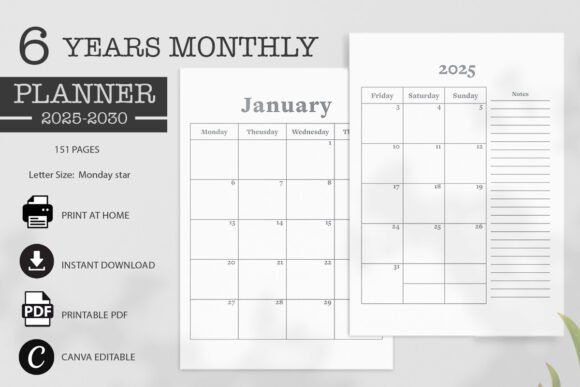
6-Year Monthly Planner 2025 - 2030
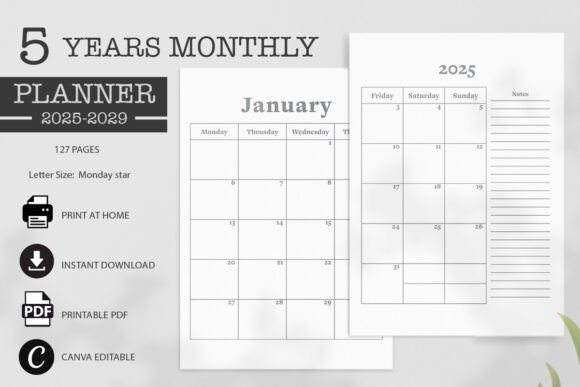
The 6-Year Monthly Planner 2025 - 2030 is more than just a tool for tracking dates—it's a strategic asset for designers, marketers, and creative professionals who want to maintain clarity and direction over an extended period. In a fast-paced industry where visual communication and branding are paramount, having a structured approach to planning can significantly enhance productivity and creative output.
From a graphic design perspective, the 6-Year Monthly Planner 2025 - 2030 offers a unique opportunity to align long-term goals with daily tasks. Its monthly calendar pages provide ample space for scheduling client meetings, project deadlines, and creative brainstorming sessions. This level of organization ensures that visual design projects stay on track while allowing room for spontaneous inspiration and adjustments.
Visual Design and Branding
For designers focused on branding and logo design, the 6-Year Monthly Planner 2025 - 2030 serves as a valuable resource for maintaining consistency across campaigns. By mapping out key milestones, such as brand launches or rebranding efforts, designers can ensure that every visual element—from typography to color palette—aligns with the overarching brand identity. This helps in creating a cohesive and professional presentation that resonates with the target audience.
When working on marketing materials, the planner becomes a central hub for managing timelines and creative workflows. Whether designing social media graphics, editorial layouts, or advertising campaigns, having a clear view of upcoming projects allows for better time management and resource allocation. This is especially crucial in digital marketing, where timely and visually compelling content can make a significant difference in user engagement.
Applications Across Creative Fields
The versatility of the 6-Year Monthly Planner 2025 - 2030 extends beyond traditional design disciplines. For web design and UI design, it can be used to outline development phases, testing cycles, and feature rollouts. Similarly, in UX design, it helps in planning user research sessions, prototype iterations, and feedback loops, ensuring that the final product meets both functional and aesthetic standards.
In packaging design and merchandise creation, the planner aids in coordinating production schedules, material sourcing, and quality checks. It also supports the creation of consistent visual elements across different product lines, reinforcing brand recognition and customer trust. For editorial design, it provides a structured way to plan content calendars, layout revisions, and publication deadlines, ensuring smooth collaboration between writers, editors, and designers.
Key Considerations for Designers
When selecting and using design elements, consistency, readability, and scalability are essential. The 6-Year Monthly Planner 2025 - 2030 encourages a thoughtful approach to these factors by promoting a clear visual hierarchy and organized workflow. Designers should prioritize elements that align with their brand’s aesthetics while ensuring that all assets remain accessible and adaptable across various platforms and formats.
Typography, color, and composition play a critical role in achieving a polished look. By using the planner to track typographic choices, color palettes, and layout experiments, designers can maintain a unified visual language throughout their projects. This not only enhances the overall quality of the work but also improves the user experience by creating a more intuitive and visually appealing interface.
Ultimately, the 6-Year Monthly Planner 2025 - 2030 is a powerful tool for anyone involved in creative projects. It bridges the gap between short-term tasks and long-term vision, offering a structured yet flexible approach to planning. By integrating this planner into their workflow, designers can achieve greater efficiency, creativity, and professionalism in their visual communication efforts.